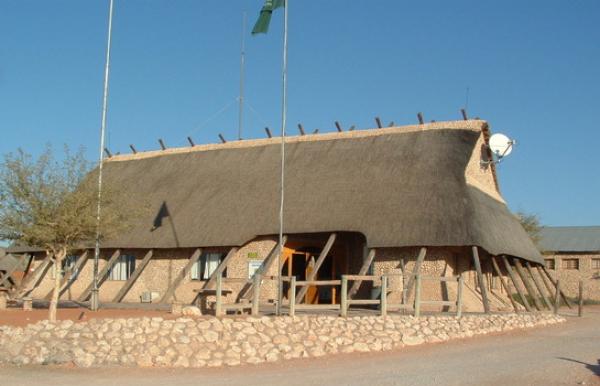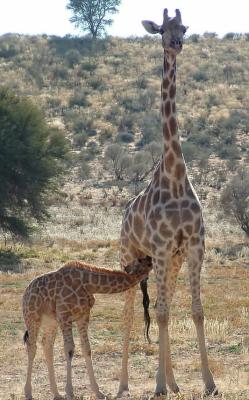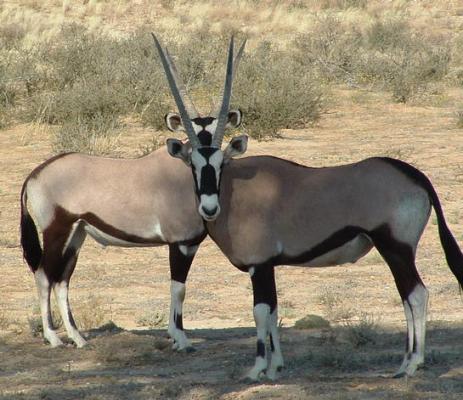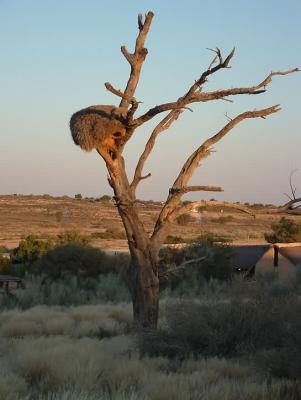
The Kgalagadi Transfrontier Park comprises an area of over 3,6 million hectares which is one of very few conservation areas of this magnitude left in the world.
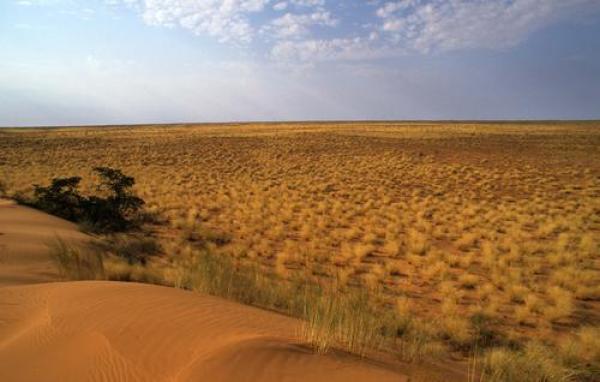
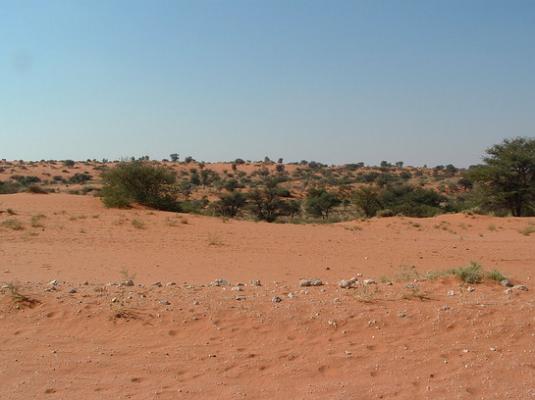
Red sand dunes, sparse vegetation and the dry riverbeds of the Nossob and Auob show antelope and predator species off at a premium and provide excellent photographic opportunities.
Kgalagadi could be considered a haven for birders especially when interested in birds of prey.
The Kalahari is an arid region with an annual rainfall of 200 mm, mainly between January and April. In summer, day temperatures may exceed 40C. Winter days are sunny with night temperatures often below zero. Visitors should anticipate extreme heat during the day and extreme cold during winter nights.
Access to the Park can be gained through five gates in three different countries:
- South Africa access is through the Twee Rivieren gate (immigration control gate)
- Namibia through the Mata-Mata gate (currently closed)
- Botswana through the Two Rivers, Mabuasehube and Kaa gates (currently closed)
Passports are not required for entry, unless departure is planned through a different gate into another country.
Tourists are required to stay over for two nights in one or more of the overnight facilities of the Kgalagadi if the intention is to travel from one country to another.
Kgalagadi Accommodation options include six different camps of varying size, facilities and cost.
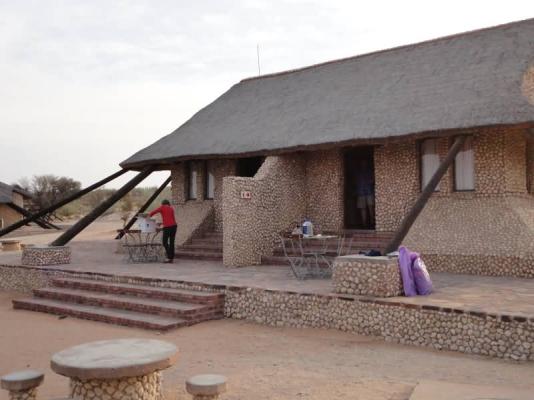
Three traditional rest camps have a basic shopping facility and fuel. The three wilderness camps, with no fences, invite the Kalahari and the tranquillity of Africa right into your room.
Bitterpan
Grootkolk
Kalahari Tent Camp
Camping is available at Polentswa, Rooiputs, Two Rivers and in Mabuasehube. A 4x4 vehicle is necessary to access the Botswana side of the Park.
All routes within Botswana are to be travelled by no less than two vehicles.
Please Note rates do not include daily conservation levies. Please see details of Conservation Fees
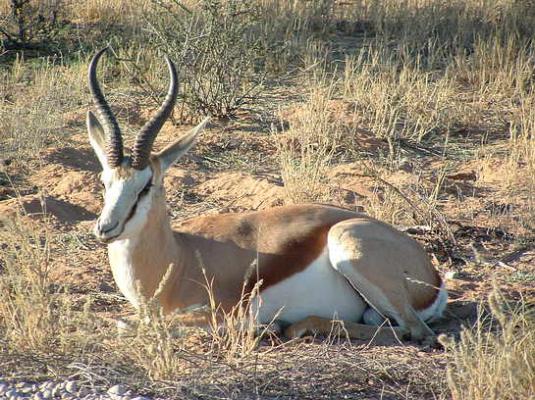
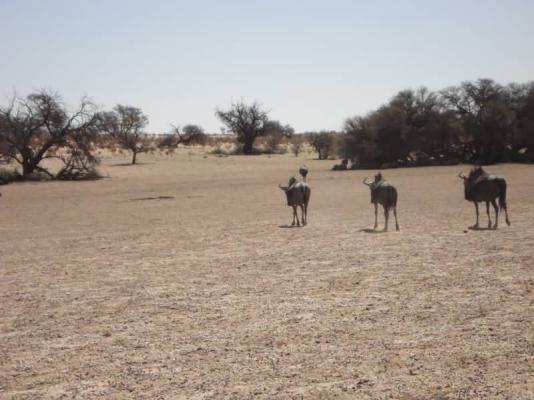
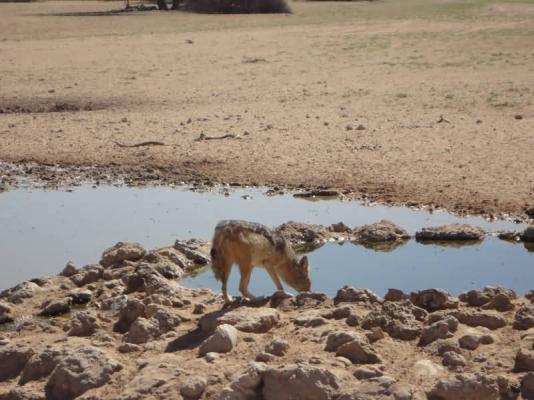
Because of the sparse vegetation and concentration of animals in the dry riverbeds of the Auob and Nossob Rivers, Kgalagadi offers premium mammal viewing. It is especially renowned for predator watching and for the seasonal movement of large herbivores such as blue wildebeest, springbok, eland and red hartebeest.
Ground Squirrel and Suricate (Meerkat) are two more of the parks more prominent species. Honey Badger (Ratel), Pangolin (Scaly Anteater) and Bat-eared Fox are some of the park specials to search for.
A variety of raptors may be seen, the commonest being Tawny and Blackbreasted Snake Eagle, Bateleur, Whitebacked and Lappetfaced Vulture, as well as smaller species such as Pale Chanting Goshawk, Gabar Goshawk, Pygmy Falcon and Greater Kestrel.
The Nossob Riverbed is rated as one of the best places in South Africa to view raptors, particularly during the summer months when large numbers of migratory eagles, kites and falcons move through the park.
Twee Rivieren from Upington - 260 km (tar road).
Visitors must allow for the following travelling time from Twee Rivieren entrance gate, to the other camps:
Nossob - 4.5 hours
Grootkolk - 7.5 hours
Gharagab - Not possible in one day
Bitterpan - 6.5 hours
Kieliekrankie - 1.5 hours
Urikaruus - 2.5 hours
Kalahari Tent Camp - 3.5 hours
Mata Mata - 3.5 hours
Guests travelling to Twee Rivieren via Upington (Askham) must note that the tarring of the road has been completed. The road via Van Zylsrus must not be driven at a high speed as the gravel section on this route is badly corrugated.
Kindly note that the roads in the Kgalagadi are not sedan friendly and that sedan vehicles find it difficult to cope with the road conditions and that some roads might not be accessible when wet, although management intervenes to maintain the roads on a regular basis. Only guests staying at Bitterpan and Gharagab are allowed to make use of 4X4 roads to Bitterpan and Gharagab. NO TRAILERS ALLOWED ON THESE ROADS.
Hired cars may be collected at Twee Rivieren provided that an advance booking was made.
When driving from one rest camp to the other, travelers should depart before 12:00 to ensure arrival before sunset as no travelling is allowed in the park after dark.
Binoculars and cameras should be easily accessible at all times
Stopping for little things often produces interesting things that were not apparent.
Reed Cabin (RC2): 2 single beds, 4x4 access only, no trailers allowed, Check in at Nossob Rest Camp, Communal kitchen and braai area, Gas and solar energy, Gas fridge / freezer, No additional persons allowed, No children under 12 allowed, No smoking, Separate bathroom with wc and shower, Un-fenced camp, Utensils.
Reed Cabin (RCZ2): 2 single beds, 4x4 access only, no trailers allowed, Check in at Nossob Rest Camp, Communal kitchen and braai area, Gas and solar energy, Gas fridge / freezer, No additional persons allowed, No children under 12 allowed, No smoking, Separate bathroom with wc and shower, Un-fenced camp, Unit accessible to the mobility challenged, Utensils.
Log Cabin (LC2): 1 bedroom with 2 single beds, 4x4 access only, no trailers allowed, Barbeque facilities on deck, Check in at Nossob (164km away), Closest shop and filling station at Nossob, Equipped kitchen, Gas fridge / freezer, No additional persons allowed, No children under 12 allowed, No smoking, Provide own drinking water and firewood, Solar power for lights, gas for hot water, Unfenced camp, tourism assistant on duty, WC and shower.
Desert Cabin (SC2): 2 single beds, Communal kitchen and braai area, Gas fridge / freezer, Hotplate, No additional persons allowed, No children under 12 allowed, No smoking, Provide own drinking water and firewood, Sink, Utensils, WC and shower.
Desert Tent (DT2): 1 bedroom with 2 single beds, Beware of hyenas in camp. Do not feed them, Gas and solar energy, Kitchen, Mata-Mata 3km away, No additional persons allowed, No smoking, Un-fenced camp, WC and shower, Wooden deck and braai.
Desert Tent (DTZ2): 1 bedroom with 2 single beds, Beware of hyenas in camp. Do not feed them, Gas and solar energy, Kitchen, Mata-Mata 3km away, No additional persons allowed, No smoking, Un-fenced camp, Unit accessible to the mobility challenged, WC and shower, Wooden deck and braai.
Family Desert Tent (FDT4): 1 bunk bed, 2 single beds, Beware of hyenas in camp. Do not feed them, Gas and solar energy, Kitchen, Mata-Mata 3km away, No additional persons allowed, No smoking, Un-fenced camp, WC and shower, Wooden deck and braai.
H/moon Desert Tent (HMT2): 1 double bed, Beware of hyenas in camp. Do not feed them, Gas and solar energy, Kitchen, Mata-Mata 3km away, No additional persons allowed, No smoking, Un-fenced camp, WC, shower and bath, Wooden deck and braai.
Dune Cabin (DC2): 1 bedroom with 2 single beds, Barbeque facilities on deck, Check in at Twee Rivieren or Mata Mata, Closest shop and filling station at Twee Rivieren, Equipped kitchen, Gas fridge / freezer, No additional persons allowed, No children under 12 allowed, No smoking, Provide own drinking water and firewood, Solar power for lights, gas for hot water, Unfenced camp, tourism assistant on duty, WC and shower.
Dune Cabin (DC2Z): Barbeque facilities on deck, Check in at Twee Rivieren or Mata Mata, Closest shop and filling station at Twee Rivieren, Equipped kitchen, Gas fridge / freezer, No additional persons allowed, No children under 12 allowed, No smoking, Provide own drinking water and firewood, Solar power for lights, gas for hot water, Unfenced camp, tourism assistant on duty, Unit accessible to the mobility challenged, WC and shower.
Camp Site (CK6P): Extra vehicles are charged a fee per night, Internal roads not suitable for sedan vehicles, No electricity from 21h30 - 05h00 daily, PowerPoint
Chalet (CH2): 1 bedroom with 2 single beds, Air-conditioned, Air-Conditioning, Barbeque facilities, Fan, Fridge, Hotplate, Internal roads not suitable for sedan vehicles, No additional persons allowed, No electricity from 21h30 - 05h00 daily, No electricity from 21H30- 05H00 daily, No smoking, Sink, Utensils, WC and shower.
Chalet (FCH6): 1 bedroom with 2 single beds, 1 bedroom with double bed, 2 single beds in lounge, Air-conditioned, Fan, Internal roads not suitable for sedan vehicles, Kitchen, No additional persons allowed, No electricity from 21h30 - 05h00 daily, No smoking, WC and shower.
River Front Chalet (RF2): 1 bedroom with 2 single beds, Air-conditioned, DSTV (limited channels), En-suite bathroom with shower, Fridge/ freezer, Kitchen, fully Equipped, Lounge, No additional persons allowed, No electricity from 21h30 - 05h00 daily, No electricity from 21H30- 05H00 daily, No smoking, Patio Braai Area, Riverfront View.
River Front Chalet (RF4): 1 bedroom with 2 single beds, 1 bedroom with double bed, Air-conditioned, DSTV (limited channels), En-suite Bathroom with WC & Shower, Fridge/ freezer, Kitchen, fully Equipped, Lounge, No additional persons allowed, No electricity from 21h30 - 05h00 daily, No electricity from 21H30- 05H00 daily, No smoking, Patio Braai Area, Riverfront View, Sink.
River Front Chalet (RF4Z): 1 bedroom with 2 single beds, 1 bedroom with double bed, Accessible to Mobility Challenged, Air-conditioned, DSTV (limited channels), En-suite Bathroom with WC & Shower, Fridge/ freezer, Kitchen, fully Equipped, Lounge, No additional persons allowed, No electricity from 21h30 - 05h00 daily, No smoking, Patio, Braai Area, Riverfront View, Sink.
Camp Site (CK6P): Extra vehicles are charged a fee per night, No electricity from 21h30 - 05h00 daily, PowerPoint.
Camp Site Premium (CK6PP): Extra vehicles are charged a fee per night, Maximum 2 vehicles per site, PowerPoint, Private ablution facility per site (Wc & Shower), Private kitchenette per site (basin only), Self-service during stay.
Chalet (CH2): 1 bedroom with 2 single beds, Fan, Fridge, Hotplate, No additional persons allowed, No electricity from 21h30 - 05h00 daily, No electricity from 21H30- 05H00 daily, No smoking, Pergola and Braai, Sink, Utensils, WC and shower.
Chalet (CH3Z): 1 bedroom with 3 single beds, Fan, Fridge, Hotplate, No additional persons allowed, No electricity from 21h30 - 05h00 daily, No smoking, Pergola and Braai, Sink, Unit accessible to the mobility challenged, Utensils, WC and shower.
Chalet (CH3): Fan, Fridge, Hotplate, Internal roads not suitable for sedan vehicles, No additional persons allowed, No electricity from 21h30 - 05h00 daily, No smoking, Pergola and Braai, Sink, Utensils, WC and shower.
Chalet (CH4): 1 bedroom with 2 single beds, 2 stack beds on stoep (children ONLY), Fan, Fridge, Hotplate, No additional persons allowed, No electricity from 21h30 - 05h00 daily, No smoking, Pergola and Braai, Sink, Utensils, WC and shower.
Chalet (CH6): 1 bedroom with 2 single beds, 1 bedroom with double bed, Double sleeper couch (not suitable for adults), Fan, Fridge, Hotplate, Internal roads not suitable for sedan vehicles, No additional persons allowed, No electricity from 21h30 - 05h00 daily, No smoking, Pergola and Braai, Sink, Utensils, WC, shower and bath.
Family Cottage (FA6): 1 bedroom with 2 single beds, 1 bedroom with double bed, Double sleeper couch (not suitable for adults), Fan, Kitchen, No additional persons allowed, No electricity from 21h30 - 05h00 daily, No smoking, Pergola and Braai, WC and shower.
River Front Chalet (RF2): 1 bedroom with 2 single beds, Air-conditioned, DSTV (limited channels), En-suite bathroom with shower, Fridge/ freezer, Kitchen, fully Equipped, Lounge, No additional persons allowed, No smoking, Patio, Braai Area, Riverfront View.
River Front Chalet (RF4): 1 bedroom with 2 single beds, 1 bedroom with double bed, Air-conditioned, DSTV (limited channels), En-suite Bathroom with WC & Shower, Fridge/ freezer, Kitchen, fully Equipped, Lounge, No additional persons allowed, No smoking, Patio Braai Area, Riverfront View.
River Front Chalet (RF4Z): Z = Accessible to Mobility Challenged
Camp Site (CK6P): Extra vehicles are charged a fee per night, Internal roads not suitable for sedan vehicles, PowerPoint.
Cottage (FA2Z): 1 bedroom with 2 single beds, Air-conditioned, Fully Equipped, Internal roads not suitable for sedan vehicles, Kitchen includes 2 plate stove and fridge/freezer, No additional persons allowed, No smoking, Unit accessible to the mobility challenged, WC and shower.
Family Chalet (FCH6): 2 bedrooms, each with 2 single beds, 2 single beds in lounge, Air-conditioned, Fully Equipped, Internal roads not suitable for sedan vehicles, Kitchen includes 2 plate stove and fridge/freezer, No additional persons allowed, No smoking, WC and shower.
Family Cottage (FA2/4A): 1 bedroom with 2 single beds, 2 single beds in kitchen area, Air-conditioned, Fully Equipped, Internal roads not suitable for sedan vehicles, Kitchen includes 2 plate stove and fridge/freezer, No additional persons allowed, No smoking, WC and shower.
Family Cottage (FA2/4ZA): 1 bedroom with 2 single beds, 2 single beds in kitchen area, Air-conditioned, Fully Equipped, Internal roads not suitable for sedan vehicles, Kitchen includes 2 plate stove and fridge/freezer, No additional persons allowed, No smoking, Unit accessible to the mobility challenged, WC and shower.
Family Cottage (FA3): 3 single beds, Air-conditioned, Fully Equipped, Internal roads not suitable for sedan vehicles, Kitchen includes 2 plate stove and fridge/freezer, No additional persons allowed, No smoking, Open plan unit, kitchen and sleeping area combined, WC and shower.
- No cancellation fee will be incurred for cancellations made after payment of first deposit up to and including 46 days prior to arrival.
- Cancellation fees equal to 50% of the total reservation cost is payable in a case of cancellation made between 45 days and 30 days prior to arrival.
- Cancellation fee equal to 100% of the total reservation cost is payable in a case of a cancellation made between 29 days prior to and date of arrival
- 100% of the total cost for any non-arrival/no-shows
Reservation made within 45 days prior to arrival is payable within 24 hours from the day reservation is made.
- Conservation levy is always excluded from the booking amount and needs to be settled on arrival.
It is your responsibility to check if the reservation is correct. Should the reservation be incorrect, please contact our office immediately.
If the arrival date of the itinerary is postponed prior to or on date of arrival and then cancelled at a later stage, the fees that applied at the time of amendment will be enforced if the amount is greater than the new cancellation fees.
Cancelling or downgrading of a reservation 45 days prior to or on arrival will result in cancellation fees according to a sliding scale (based on the total reservation cost) which varies between 50% and 100%.
Should the reservation not be taken up on the arrival date the accommodation will be held until 09:00 the following day after which the reservation will be cancelled and the deposit, where applicable, forfeited.
The entrance at Twee Rivieren Gate is situated approximately 260 km north from Upington.
Tourists from Johannesburg have a choice of two routes, either via Upington (60 km gravel) or via Kuruman, Hotazel and Vanzylsrus (340 km gravel).
Daily flights to Upington from Johannesburg and Cape Town are available.
Gate Hours are:
Summer - 06:00 - 19:30
Winter - 07:30 - 18:00